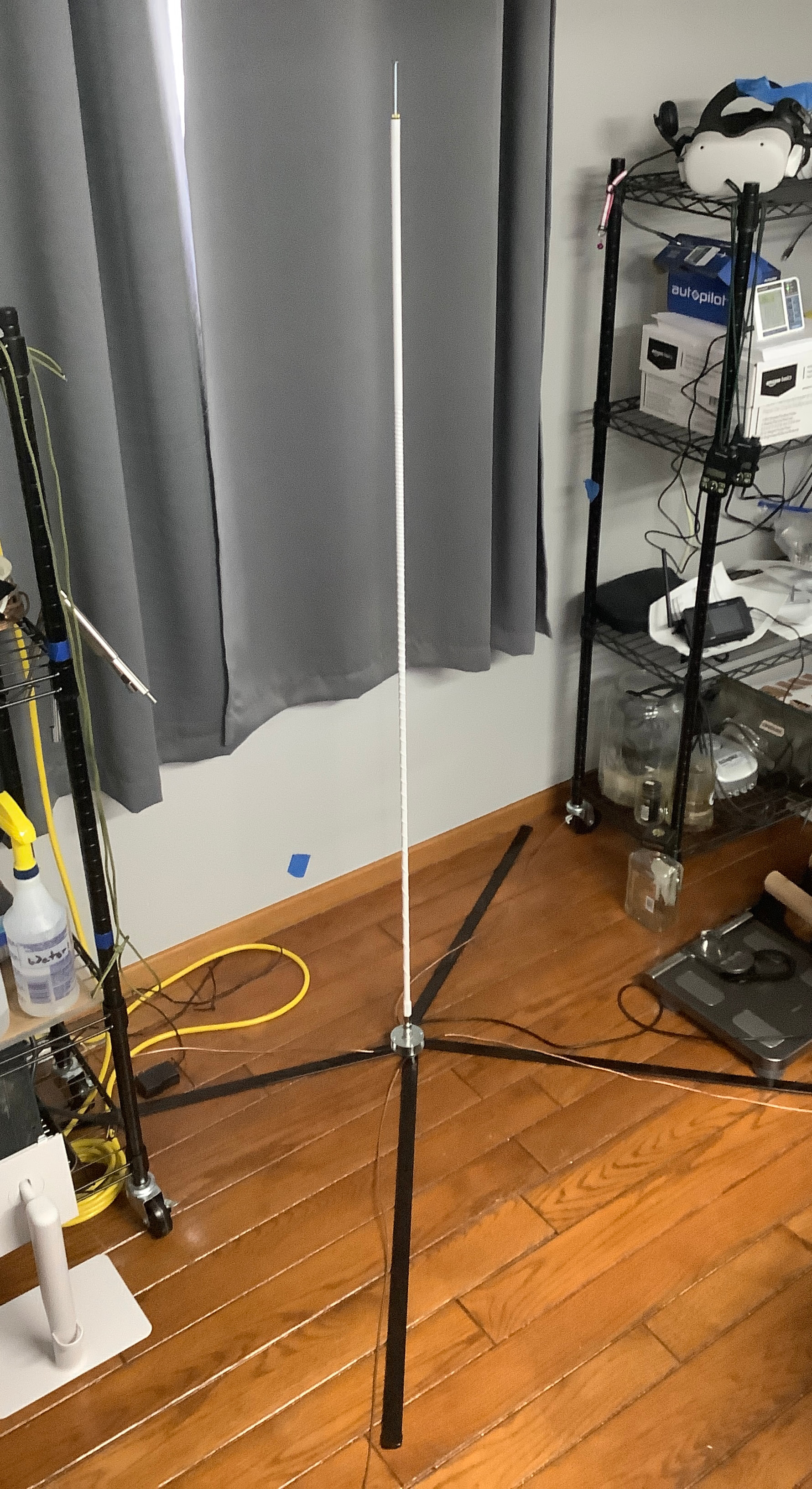
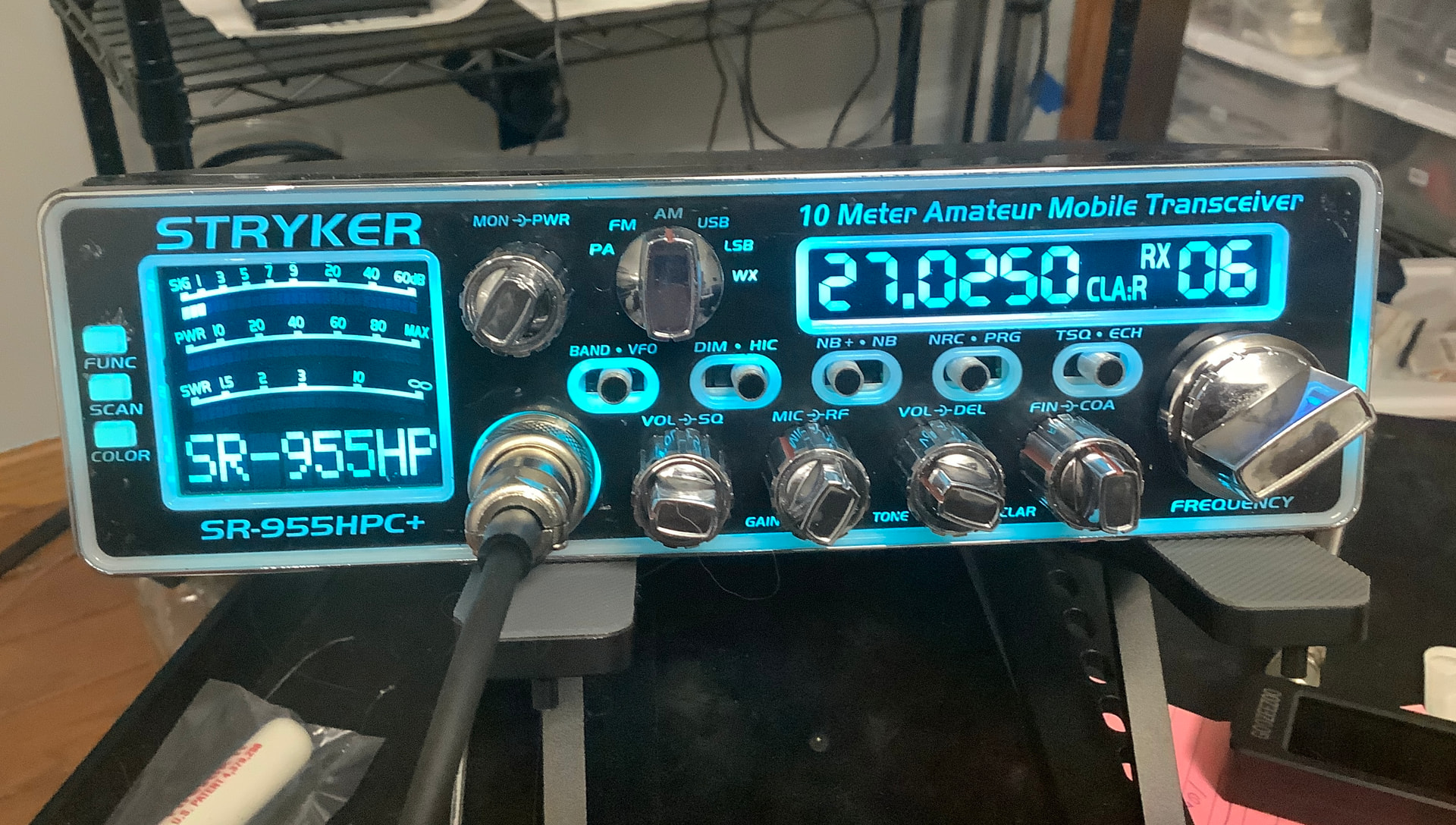
Using a Firestik IBA-5, a handful of DIY 8.5 ft radial wires (Amazon basics speaker wire), a NanoVNA, this station has evolved into something surprisingly effective—especially on Channel 38 LSB, the SSB DX watering hole.
This is a technical overview of the entire setup: the antenna, the tuning process, the radials, the NanoVNA workflow, and the reasoning behind optimizing specifically for SSB DX.
 Station Overview
Radio:
Stryker SR-955HPC+, expanded for CB but still a highly capable 10-meter-class transceiver.
- Excellent SSB performance
- Adjustable RF power
- Built‑in SWR meter
- Flexible IF and DSP-like features (NRC, NB, Hi-Cut)
Antenna:
Firestik IBA-5 — a 5-foot, base-loaded ¼-wave indoor CB antenna.
It is compact but electrically short, so it relies heavily on:
- a base loading coil
- a tuning screw (acting as a mini capacitive hat)
- a stable RF ground system
Location:
The attic, approximately 20–25 feet above ground level, surrounded by typical materials (wood, insulation, wiring, ductwork).
Without intervention, these materials distort RF behavior but the radial system solves this.
Test Equipment:
NanoVNA (Vector Network Analyzer)
The NanoVNA is a critical part of this station’s design philosophy. Instead of treating SWR as a single number mystery, the NanoVNA provides complete visibility into the antenna’s electrical behavior.
Why it matters:
- Displays full SWR curve from 26–28 MHz
- Shows the exact resonant frequency
- Reveals reactance and impedance
- Allows live, real-time tuning of the IBA-5’s adjustable tip
- Confirms radial effectiveness and attic detuning effects
- Enables precision targeting of 27.385 MHz (CH 38 LSB)
Key Features Used in This Setup:
- 201-point sweep resolution
- SMA → SO-239 adapter for CB coax
- Continuous sweep mode for real-time tuning feedback
- Marker placement to zoom into SSB window
- Ability to save screenshots for documentation and future comparison
Without the NanoVNA, tuning a high-Q, shortened vertical in an attic would be guesswork.
With the NanoVNA, the process becomes empirical, repeatable, and even fun.
🜂 Building a Real Ground Plane Indoors
Using Amazon Speaker Wire Radials
Most indoor antennas fail because the house becomes part of the RF circuit.
To prevent the attic from acting as a chaotic, lossy ground, I built a controlled ground plane from:
→ Four radials, each 8.5 ft long, cut from inexpensive Amazon speaker wire.
Speaker wire splits neatly, so each radial is literally:
- ONE conductor of typical 18-gauge copper speaker cable
- Exactly quarter-wave for CB frequencies
The radials are spaced evenly around the IBA-5’s mounting point, forming a spoke-like ground system.
The effect was dramatic:
- SWR stabilized across the band
- Receive noise dropped
- The antenna stopped shifting frequency with minor movement
- Bandwidth widened
- Efficiency improved
- Patterns became predictable rather than random
For under $10, the radials turned the IBA‑5 from “an indoor stick” into a true shortened 1/4-wave vertical with a controlled RF environment.
 The Secret Weapon: The Tuning Screw
The IBA‑5’s tuning screw isn’t just a trim adjustment—it’s part of the antenna’s electrical length.
Because the antenna is physically shorter than ¼-wave, the tuning screw:
- Adds top-loading capacitance
- Allows frequency targeting
- Offers extremely fine resolution tuning
- Shifts resonance by tens or hundreds of kilohertz with small turns
This high sensitivity is due to the antenna’s high-Q resonance curve.
Why this matters:
Most CB antennas are broadband and cannot be “aimed” at one SSB channel.
The IBA‑5 can and because SSB is narrowband, tuning the antenna to the exact frequency (27.385 MHz) yields noticeable improvements.
 Precision Tuning with the NanoVNA
The NanoVNA transforms the tuning process from guesswork into science.
Workflow:
- Attach NanoVNA to coax with SMA→SO‑239 adapter
- Set sweep: 26–28 MHz
- Watch for the resonance dip
- Adjust tuning screw
- Let go, step back (body detunes antenna), observe stable reading
- Repeat until the dip sits exactly on 27.385 MHz
The ability to watch the SWR curve slide in real time while adjusting the screw is game-changing. It transforms an attic compromise antenna into a precision-tuned resonant device.
 Why Tune Specifically for Channel 38 LSB?
Channel 38 LSB (27.385 MHz) is the SSB DX hub of CB radio.
By tuning the antenna’s narrow resonance peak to this exact frequency:
Transmit Benefits
- Maximum forward power
- Minimal reflected power
- Highest radiation efficiency at DX angles
- Cleaner audio
- Maximum punch-per-watt
Receive Benefits
- Better sensitivity to weak signals
- Lower noise floor
- Reduced reactance induced distortion
A broadband outdoor antenna doesn’t need this level of precision.
An indoor shortened vertical absolutely benefits from it.
 Performance Comparison: IBA-5 + Radials vs. Common CB/11m Antennas
| Antenna Type | DX (Skip) | Local (0–20 mi) | Noise Rejection | Tuning Precision | Efficiency | Attic Compatibility | Typical Range (Local) | Skip Potential | Notes |
|---|---|---|---|---|---|---|---|---|---|
| IBA-5 + Radials (my setup) |  |
|
|
|
|
|
3–10 mi | 800–1500 mi | Best indoor vertical for CB. Narrow bandwidth enables exact Ch. 38 tuning. |
| Full 1/4-wave whip (102”) | |
|
|
|
|
|
10–40 mi | 1000–2000 mi | Top outdoor performer; impractical indoors. |
| Half-wave vertical (e.g., IMAX 2000) | |
|
|
|
|
|
10–50 mi | 1500–4000 mi | Excellent efficiency; large and noisy. |
| Fiberglass base antenna (A99, etc.) | |
|
|
|
|
|
10–35 mi | 1200–2500 mi | Broad-banded and easy to use; not channel-specific. |
| Attic dipole (horizontal) | |
|
|
|
|
|
10–60 mi | 200–800 mi | Excellent local coverage; poor skip due to high-angle radiation. |
| EFHW wire | |
|
|
|
|
|
8–30 mi | 300–1200 mi | Versatile long-wire option; not razor-tunable. |
| Magnetic loop | |
|
|
|
|
|
1–5 mi | 500–1200 mi | Very quiet but difficult to tune and low efficiency. |
Why the IBA-5 + Radials Makes Sense in an Attic Setup
 Best overall performance indoors
Other CB antennas suffer heavily in attics: size limitations, detuning from nearby materials, poor counterpoise, or radiation patterns that favor straight up rather than out.
The IBA‑5:
- Fits properly indoors
- Uses the added speaker wire radials as a stable counterpoise
- Maintains a usable low‑angle radiation pattern for DX
One of the few CB antennas that benefits from precision tuning
Most CB antennas are intentionally broadbanded their SWR/impedance curve barely changes across Ch. 1–40.
The IBA‑5, being a shortened loaded monopole, has:
- A sharp resonance peak
- A tunable capacitive tip
- A bandwidth narrow enough for channel targeted optimization
This is ideal for Ch. 38 LSB without needing outdoor height.
Works well with tools like the NanoVNA
Since the IBA‑5 responds strongly to even small length or capacitance changes, you can:
- Visualize its sharp SWR dip
- Align that dip exactly at 27.385 MHz
- Adjust radials/tip length in real time
This level of precision simply isn’t meaningful on an A99 or 102” whip.
 “Can It Be Tuned Precisely to Channel 38?” — Comparison Table
| Antenna | Bandwidth | Can It “Target” 38 LSB? | Why Not? |
|---|---|---|---|
| 102″ whip | Very wide |  No No |
Resonant across entire band |
| Antron A99 | Very wide | No |
Internal broadband matching |
| IMAX 2000 | Extremely wide | No |
Impedance barely shifts |
| Dipole | Moderate | Not sharply |
Broader, flatter curve |
| EFHW | Moderate | No |
Transformer limits sharp tuning |
| IBA-5 + Radials | Narrow | YES |
High-Q resonance + tunable top tip |
Why This Choice Is Technically Ideal for My Situation
- attic restricts height → rules out tall half‑wave/5⁄8‑wave antennas
- operating mode is LSB DX → benefits from precision tuning
- environment requires controlled ground and impedance → radials solve this
- NanoVNA enables frequency‑specific optimization
- goals align with a low-angle radiator even indoors
Firestik IBA‑5 with radials is the most efficient, most controllable, and most DX-capable choice for my constraints.
 Final Thoughts
This entire indoor system works because every variable is controlled:
- Precise radials
- A tunable capacitive hat
- NanoVNA-assisted calibration
- A stable attic mounting location
- A focus on a single highly active DX channel
It is not a tower. It is not a beam.
But for an indoor CB/SSB station, it punches far above its weight because it’s engineered not improvised.
More updates will follow as I gather VNA sweeps, placement maps, and real-world reports from 38 LSB.